


But before we explore the history and cultural significance of this madrasa, let’s first say a few words about the Seljuks and the state that ruled much of Anatolia for nearly two centuries – Sultanate of Rum.
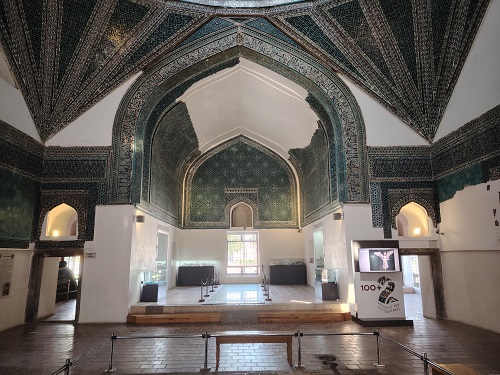
SELJUK SULTANATE OF RUM
The Seljuk Empire was governed through a family federation system, often described as an “appanage state”. Over time, different territories of the empire were divided among members of the Seljuk dynasty, gradually leading to the emergence of semi-independent states.
One of these states was the Sultanate of Rum, a Turco-Persian kingdom that ruled much of Anatolia. It separated from the Great Seljuk Empire in 1077 and existed until 1308. Its first capital was Iznik, followed later by Konya, which became the political and cultural centre of the sultanate.
The Sultanate of Rum emerged after the Seljuk victory over the Byzantine Empire at the Battle of Manzikert in 1071. Over the following centuries, the sultanate developed into one of the most prosperous states in the region. It controlled important trade routes linking Asia and Europe. They built caravanserais to support merchants travelling across Anatolia. They also sponsored the construction of mosques, madrasas, hospitals and public works. Many of the finest examples of Seljuk architecture in Turkey date from this period.
KARATAY MADRASA
Emir Celaleddin Karatay commissioned the Karatay Madrasa in 1251, during the reign of Sultan Izzeddin Keykuvas II.
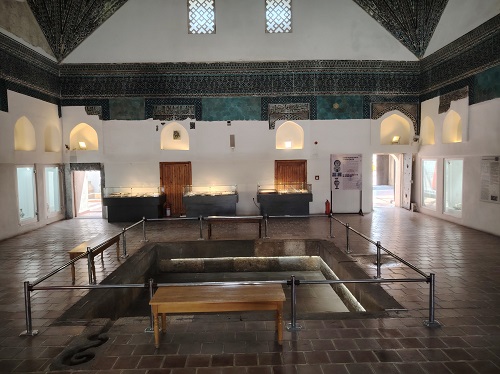
The madrasa continued to be used during the Ottoman period, but was abandoned towards the end of the 19th century.
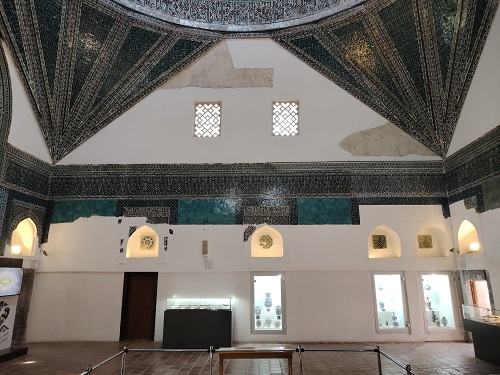
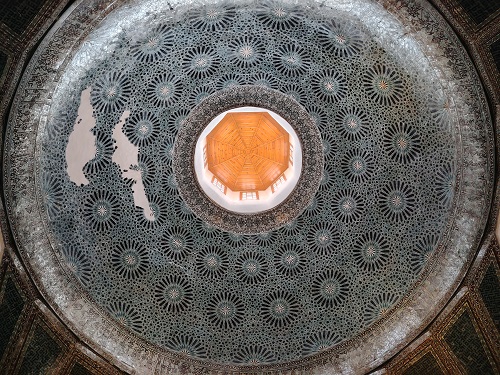
Today, it occupies and important place in the history of Anatolian Seljuk architecture and is particularly famous for its magnificent tile decoration.
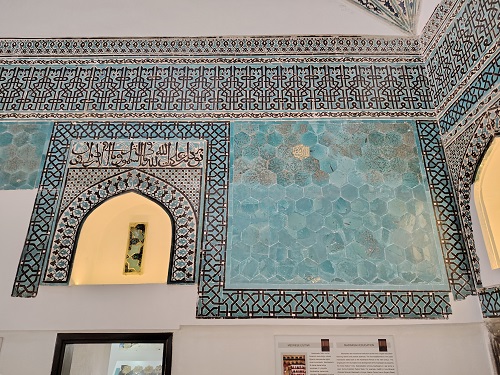
The madrasa opened as the Tile Works Museum in 1955 and it remains one of the best places in Konya to see Seljuk tiles, ceramics and decorative arts.
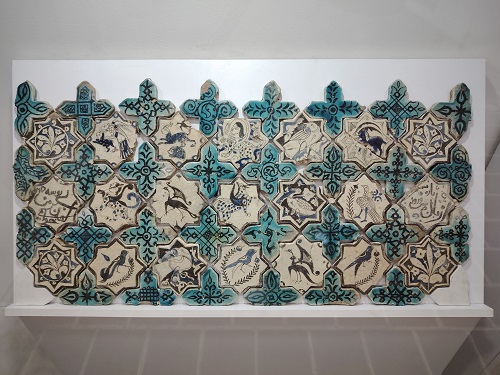
Tiles in this photo, originally from the Kubad Abad Palace, are now exhibited at the Karatay Tile Works museum. The museum displays an important collection of tiles, ceramics and other decorative objects from the Seljuk and Ottoman periods. The Kubad Abad finds are among its most remarkable exhibits.
EMIR CELALEDDIN KARATAY
It is not known exactly where or when the Seljuk statesman Celaleddin Karatay was born and his family origins remain uncertain. Historical sources indicate that he was already in state service during the reign of Sultan Keykavus I, whose rule started in 1211. Karatay served the Seljuk state for approximately four decades. He earned the confidence and respect of successive sultans, members of the palace and the wider public.
During his early career, he served as a secretary in the Seljuk administration. He later held important positions under Sultan Alaeddin Keykubad I and became one of the most influential statesmen of the Sultanate of Rum. After Keykubad I died in 1237, Karatay continued his service during the reign of his son, Giyaseddin Keyhüsrev II.
Celaleddin Karatay eventually became Atabeg-i Rum of the Sultanate of Rum, in 1249. He retained this influential position until his death and played a crucial role in maintaining political stability during one of the most difficult periods in the history of the Seljuk state.
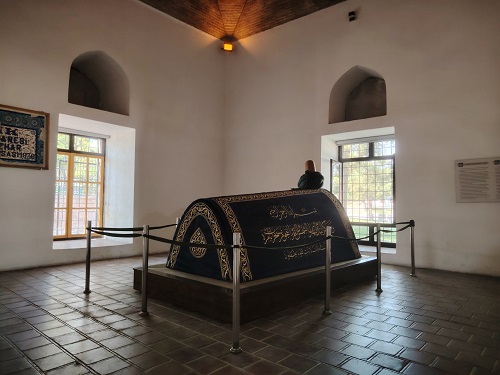
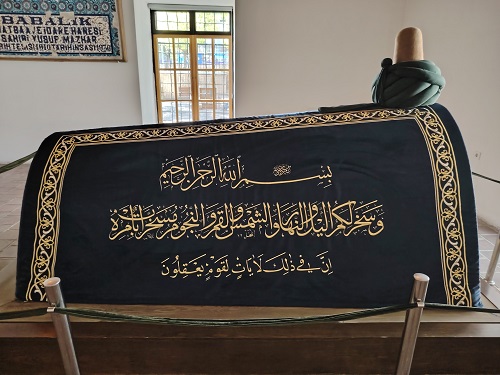
He died in Kayseri in 1254. His body was later taken to Konya, where he was buried in a tomb within the Karatay Madrasa that he commissioned.
This respected statesman served several Seljuk sultans and played an important role during a period of political instability and Mongol influence. In 1249, he helped bring an end to the struggle for the throne by establishing a system of joint rule between the three brothers – Keykavus II, Kiliçarslan IV and Keykubad II. The arrangement lasted until Karatay’s death and helped preserve the unity of the Seljuk state during a particularly turbulent period.
He also made a significant contribution to the intellectual and artistic life of the period in which he lived. The madrasa he commissioned remains one of the finest surviving examples of Seljuk architecture and decorative art in Anatolia.
SELJUK CIVILISATION
Konya offers a remarkable opportunity to explore the history of the Sultanate of Rum and its lasting influence on Anatolia. The city is included on UNESCO’s Tentative List for World Heritage Sites, under the title “Konya – A Capital of Seljuk Civilisation”. This reflects its exceptional importance as one of the great centres of Seljuk civilisation.
Outside Konya, the vast Seljuk legacy extends across Anatolia and beyond. Cities such as Diyarbakir and Kayseri are home to important Seljuk-era monuments and historic buildings. The Karatay Madrasa adds to the wealth of this remarkable heritage and remains a true gem of Seljuk architecture, art and culture.
Back to Turkey