


While reading about Aksaray before my trip, I was curious about the name Karamanid. My knowledge of Seljuk and Ottoman history in Anatolia is fairly solid. So, I initially assumed that the mosque dated back to the Seljuk period. However, the Seljuk Sultanate of Rum came to an end in 1308.
At that time, the Ottoman Beylik was still a relatively small state, with its capital in the modest town of Söğüt. Although the Ottoman state had been established in 1299, its rapid expansion during the following decades was directed primarily westwards into the Balkans.
Therefore, the Karamanid Grand Mosque could not have belonged to either of these two powerful states that shaped Anatolian history. So, let’s have a brief look at who the Karamanids were and the role they played in medieval Anatolia.
KARAMAN BEYLIK
The Karamanids, also known as the Karaman Beylik, were one of the most powerful Turkish beyliks in Anatolia between 1250 and 1487. Their state survived until Fatih Sultan Mehmed conquered and incorporated the Karamanid territories into the expanding Ottoman Empire.
For a time, the Karamanid state coexisted alongside the Seljuk Sultanate of Rum. After the Seljuk state ceased to exist in 1308, the Karamanids moved their capital to Konya, one of the most important cities in central Anatolia.
Like the Ottomans, the Karamanids also had to deal with Mongol domination until the collapse of the Ilkhanate in 1335.
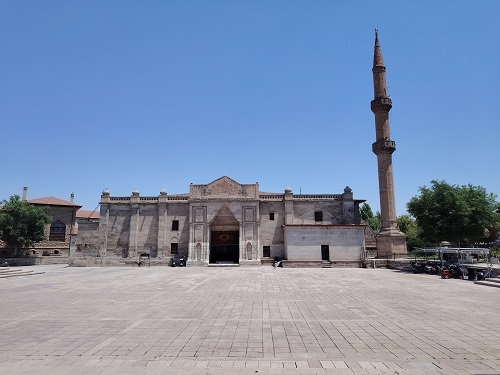
KARAMANID GRAND MOSQUE
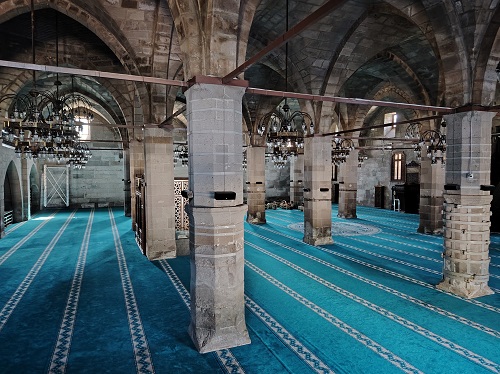
The Karamanid Grand Mosque was originally commissioned by Rükneddin Mesud, the son of the Seljuk Sultan Kılıç Arslan II. However, by the early 15th century the mosque required extensive restoration.
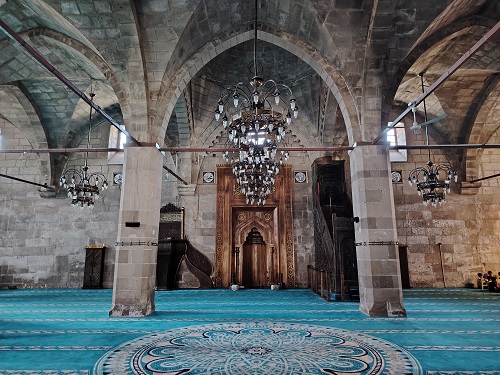
It was Karamanid ruler Mehmed Bey who ordered the reconstruction and renovation of the mosque between 1408 and 1409, giving it the appearance that it retains today. The Ottomans later referred to the building as Karamanoğlu Mehmed Bey Camii.
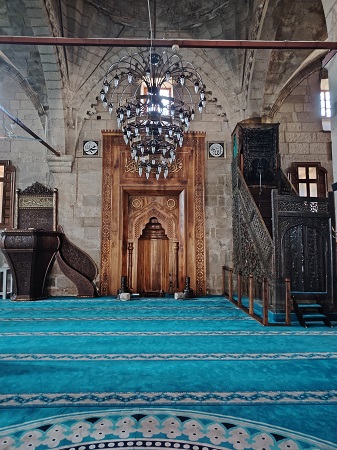
Examples of Seljuk architectural decoration adorn the mosque’s main portal, which serves as the principle entrance to this historic monument.
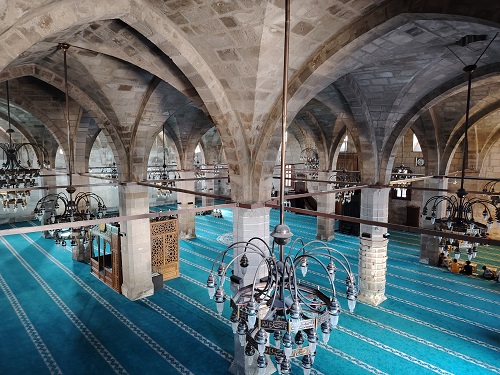
The mosque underwent further major repairs between 1482 and 1483, during the reign of Ibrahim Bey, the son of Mehmed Bey.
The minaret was added in 1925, while decorative exterior lighting was installed in 2021 as part of a restoration project initiated by the Mayor of Aksaray.
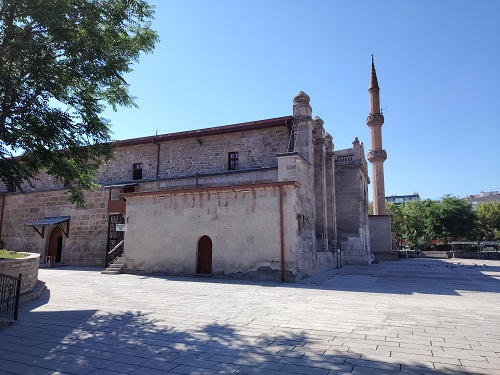
This mosque is a remarkable monument and one of the finest surviving legacies of the Karamanid dynasty, which disappeared more than 500 years ago. Together with other surviving Karamanid monuments across Anatolia, it preserves the memory of a dynasty that once rivalled its more famous neighbours.
This is precisely why I decided to stop in Aksaray. I wanted to learn more about the Karamanids and visit a monument that occupies a unique place in the history of Anatolia.
Back to Turkey