


Before we look at this majestic monument, it is worth exploring the historical context behind its construction.
DANISHMEND BEYLIK
The Danishmend ruler Melik Mehmet Gazi commissioned the mosque, which was built between 1134 and 1143. At the time, Anatolia was undergoing a period of major political change following the Battle of Manzikert in 1071. The Byzantine Empire suffered a decisive defeat and Turkish dynasties gradually established control over much of the region. One of these emerging powers was the Danishmend Beylik, which ruled from 1071 until 1178.
The Danishmends controlled the regions around Sivas, Tokat and Niksar, while their influence stretched west towards Ankara and south to Malatya. Throughout much of the early twelfth century, they were the principal rivals of the Seljuk Sultanate of Rum, whose territories surrounded much of the Danishmend domain. Although the two states frequently fought for control of central Anatolia, they also occasionally formed alliances against common enemies, including the Crusader states and the Byzantine Empire.
The Danishmend dynasty was founded by Danishmend Gazi, a military leader whose victories helped establish Turkish rule in central Anatolia. Melik Mehmet Gazi ascended the throne in 1134 and ruled until his death in 1142.
Following Melik Mehmet Gazi’s death, the beylik was divided between his two brothers. One ruled from Sivas, while the other established his authority in Malatya. This division weakened the Danishmends, making it easier for the Seljuk Sultanate of Rum to gradually absorb their territories.
The Seljuk conqust of Malatya in 1178 marked the end of the Danishmend Beylik. Many members of the dynasty subsequently entered the service of the Seljuk rulers and their architectural and cultural legacy continued to influence Anatolia for generations.
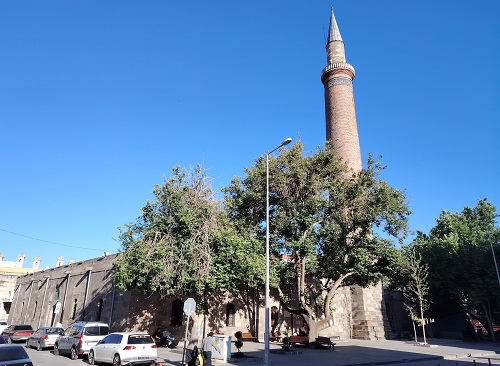
MELIK MEHMET GAZI MOSQUE (GRAND MOSQUE)
This brief historical overview helps explain the origins of the Kayseri Grand Mosque. Now more than 880 years old, the mosque is one of the oldest surviving mosques in Anatolia and one of the finest examples of early Seljuk architecture.
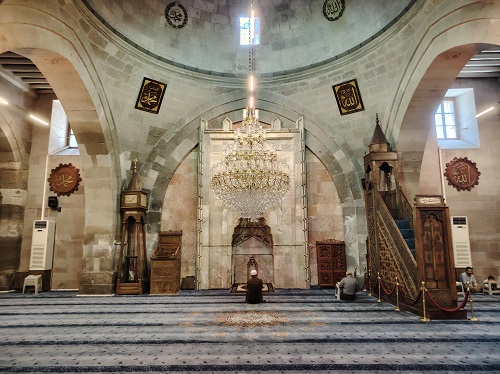
Although commissioned by Melik Mehmet Gazi, the building also reflects the transition from the architectural traditions of the Danishmends to those of the Seljuks, whose influence would later dominate the region.
Lime many early Anatolian mosques, the building is notable for its restrained exterior. The emphasis is placed on solid stone construction rather than elaborate decoration.
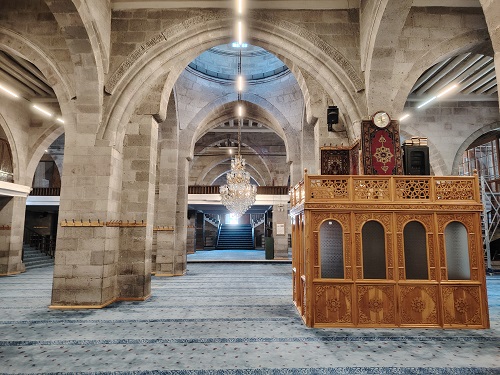
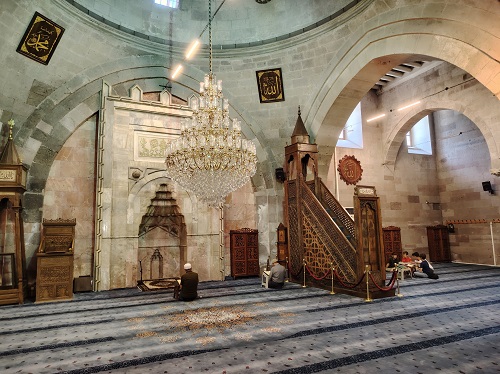
Inside, however, you find a spacious prayer hall supported by rows of stone pillars that create a sense of harmony. Over the centuries, the mosque has undergone several restorations, particularly during the Seljuk and Ottoman periods. It has remained an active place of worship for nearly nine centuries.
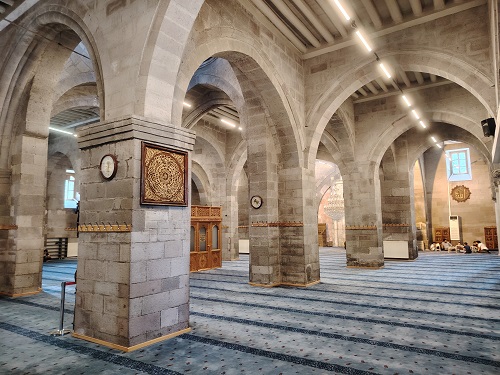
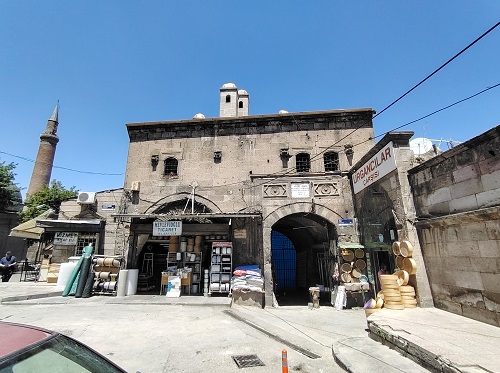
The mosque stands in the heart of Kayseri’s old town, next to the Grand Bazaar and the Vizier Han. Both were build much later during the Ottoman period.
Together with the surrounding streets, these historic buildings form one of the most atmospheric parts of the city. Walking through this area offers visitors a journey through different periods of Anatolian history, from the Danishmends and Seljuks to the Ottomans.
MELIK MEHMET GAZI TOMB
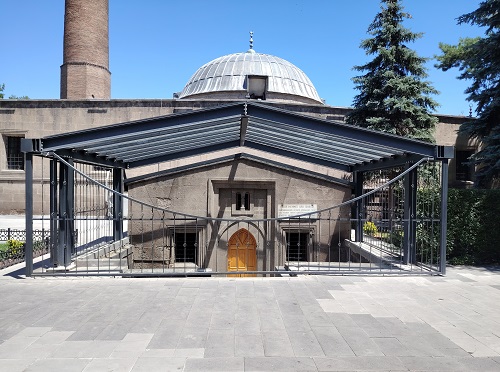
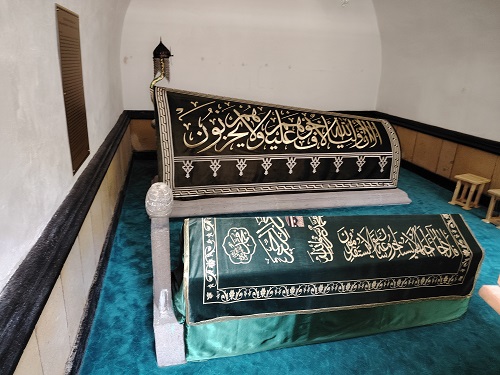
The tomb of Melik Mehmet Gazi is attached to the mosque. Even if the Melik Mehmet Gazi Mosque were the only surviving Seljuk monument in Kayseri, it would still be well worth a visit. But the city contains many more remarkable medieval monuments, including the Hunat Hatun Mosque and the Sahabiye Madrasa.
Collectively, these monuments make Kayseri one of the best destinations in Turkey for anyone interested in Seljuk architecture and medieval Islamic history. I have covered many of these remarkable buildings in my post “Seljuk Monuments in Kayseri”.
In the end, I can say that I am glad to have visited this magnificent historic monument. It is one of the oldest mosques in Kayseri and also an outstanding reminder of the city’s rich Danishmend and Seljuk heritage.
Back to Turkey