


As I had only three weeks for this second trip, I needed to plan carefully and focus on fewer destinations. I also considered the distances between cities, as I wanted to avoid spending too much time travelling. If you look at the map of Turkey, you will notice that all these places are relatively close to one another.
However, while planning this journey, I kept thinking whether it was worth stopping in Aksaray. With a population of just over 300000, Aksaray is a relatively small city and, admittedly, it is not among Turkey’s best-known tourist destinations. Still, it was conveniently located on the route from Kayseri to Konya and I had never visited it before. I was also sure that there had to be something worth seeing there. As it turned out, I was right – but I’ll come to that a little later.
IS AKSARAY WORTH VISITING?
What I did not expect, however, was something entirely different. Aksaray has only a handful of hotels. Most are located in the city centre, while another one is near the bus station. When I started looking for accommodation, I found that the centrally located hotels were surprisingly expensive, charging rates that I simply didn’t think were worth paying.
In the end, I booked the four-star Grand Çakiroğlu Hotel, near the bus station. It was an excellent choice, offering good accommodation at a very reasonable price and excellent value for money. One advantage was that I walked to the hotel from the bus station after arriving in Aksaray. The downside was its distance from the city centre, but I didn’t mind. Since I stayed for only two nights, walking around 30 minutes each way was perfectly manageable.
One lesson I learned from this is to check hotel availability and prices before planning a visit to smaller cities in Turkey and possibly in other countries too. Unfortunately, accommodation costs in Aksaray can be surprisingly high considering the limited tourist appeal. I also understand that, with relatively few visitors, hotels may need to charge higher rates to remain profitable.
MY TOUR OF AKSARAY
I remember how incredibly hot it was during my stay in Aksaray in July 2025. To avoid the worst of the heat, I started exploring the city at 8am. It turned out to be a great decision, as temperatures climbed to 39 degrees C by early afternoon. At that point, I returned to the hotel to escape the heat before going out again in the evening for dinner. The morning gave me more than enough time to visit the city’s main attractions.
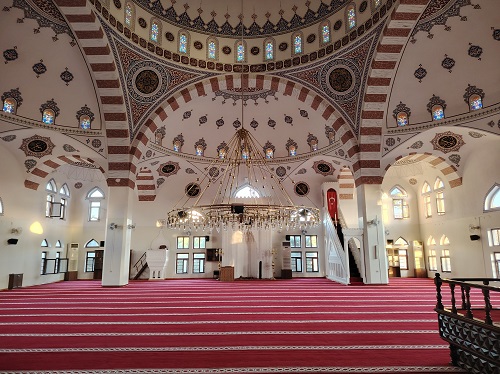
The first landmark I came across was the Cemaleddin Aksarayi Mosque. Although it is not a historic mosque, it was designed in the traditional Ottoman architectural style.
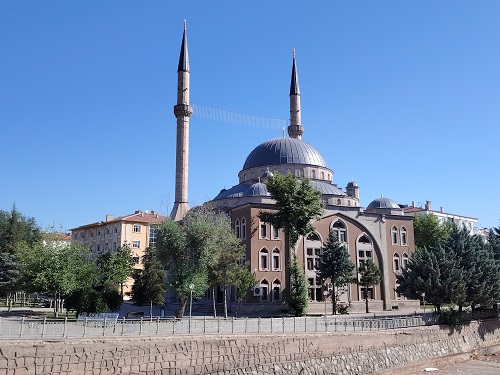
The mosque was constructed between 1979 and 1980 on the site of the original 14th century mosque, dedicated to the celebrated Islamic scholar and mystic Cemaleddin Aksaray, who died in 1389.
Although the present building has limited historical significance, it is still worth a visit if you are exploring the city centre.
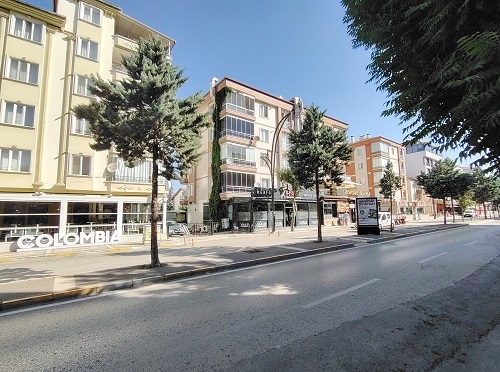
From there, I continued my walk through Aksaray. It is a modern Turkish city, with wide streets and apartment buildings that you can see in the photo below. The avenue leading towards the city centre was lined with coffee shops and restaurants, creating a lively atmosphere.
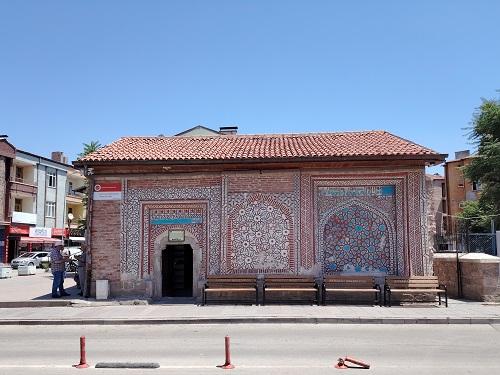
Unfortunately, I wasn’t lucky with the Cincikli Mosque. Both times I passed by, prayers were taking place, so I couldn’t see the interior. I decided not to wait because of the intense heat. The mosque dates back to the Seljuk period and was built between the mid-12th and late 13th centuries.
AKSARAY MEYDAN
Eventually, I reached the city’s main square, Aksaray Meydan. Several notable landmarks surround the square, including the Clock Tower and the Kurşunlu Mosque.
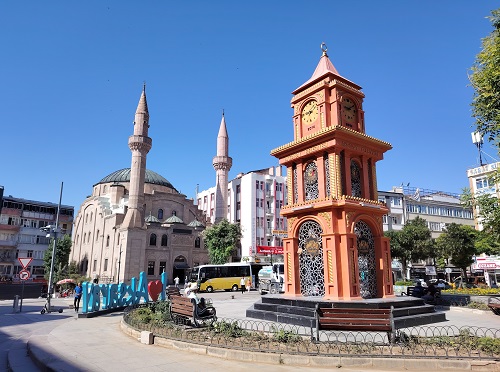
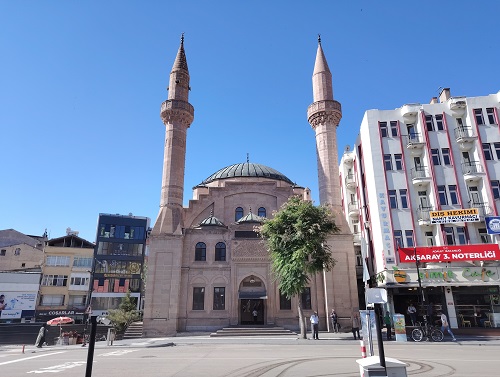
The original historic mosque was completely demolished during restoration works in 1988 and replaced with the present building. I only discovered this afterwards, as its appearance closely resembles that of an authentic Ottoman era mosque.
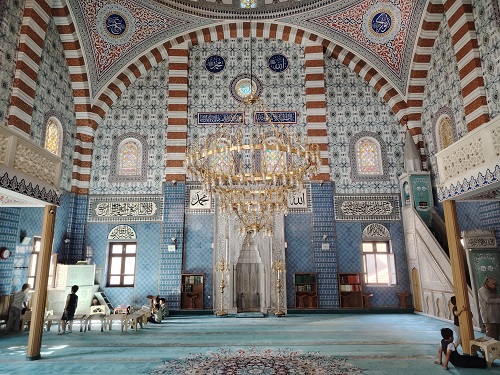
The richly decorated interior is particularly impressive and resembles some of the finest Ottoman mosques in Istanbul. During my visit, a class was taking place, with children listening to their teachers.
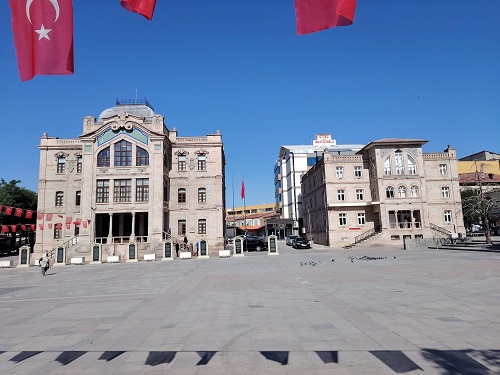
Around the square, you can also see several fascinating Early Republican government buildings constructed between 1927 and 1929. Their architecture combines Neo-Classical elements with traditional Turkish design.
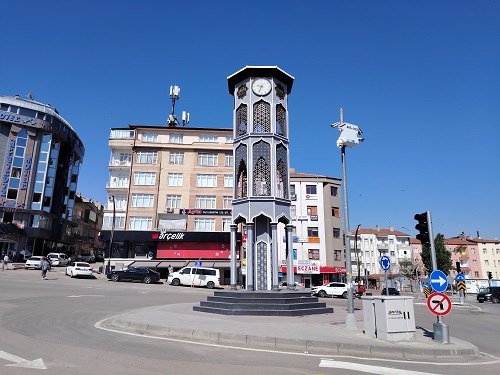
From the main square, I continued towards another clock tower.
KILIÇARSLAN II HAMMAM
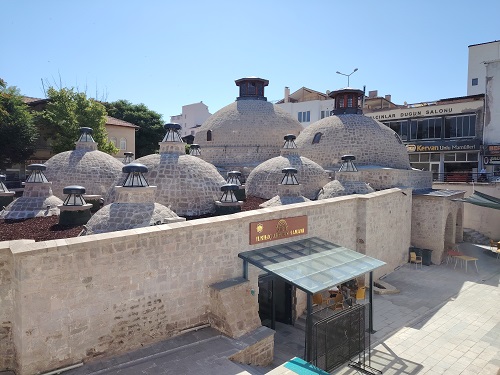
Next, I visited the Kiliçarslan II Hammam, an approximately 800 years old Seljuk bath house that today serves as an exhibition and cultural venue.
Built in the 12th century by the Seljuk Sultan Kiliçarslan II, the hammam was famous for its advanced underfloor heating system, which used terracotta pipes to circulate hot water heated by a central furnace.
When I walked past the building, I assumed it was still an operating hammam. Given the temperature outside, visiting a Turkish bath was the last thing on my mind. Looking back, I wish I had gone inside, as there was probably an art exhibition and an opportunity to see this remarkable historic building within.
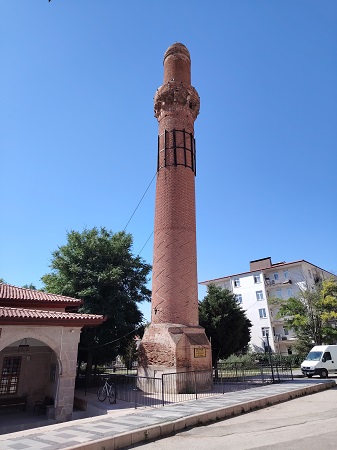
From the Kiliçarslan II Hammam, I went to the Eğri Minaret, one of Aksaray’s most famous landmarks. It was built by the Seljuks between 1221 and 1236, during the reign of Sultan Alaeddin Keykubad I.
ZINCIRIYE MADRASA
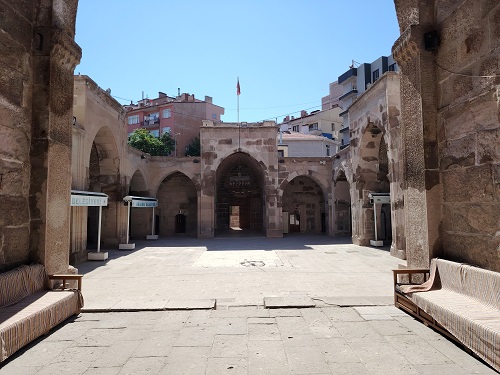
The Zinciriye Madrasa was commissioned by the Karamanid ruler Halil Mirza Bey and completed in 1336 in the classic Seljuk architectural style.
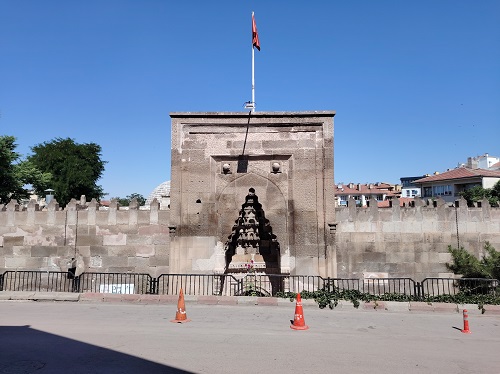
Its name comes from the chains that once hung above the entrance gate to prevent animals from entering the madrasa.
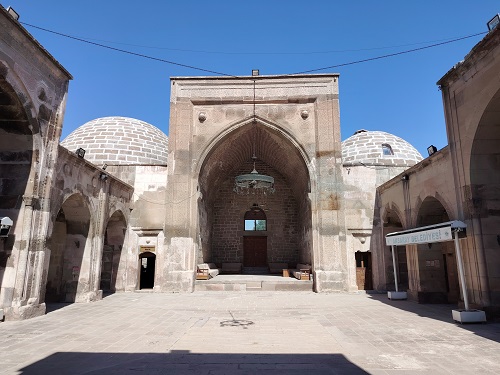
Today, the madrasa is used by the local authorities for cultural and social events. However, as you see from the photos, the interior is largely empty, allowing visitors to fully appreciate the beauty of its medieval architecture.
KARAMANID GRAND MOSQUE
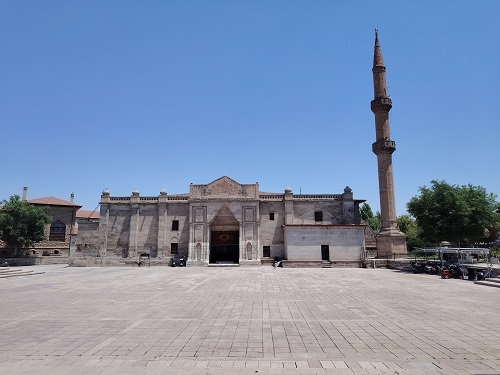
Finally, we come to the main reason why I decided t stop in Aksaray – the magnificent Grand Mosque (Ulu Camii), built by the Karamanid ruler Mehmed II between 1408 and 1409.
I will write more about this remarkable monument in my next post. One of the most fascinating aspects of the mosque is that it doesn’t belong to the Seljuk or Ottoman period. Instead, it is an important legacy of the Karamanid dynasty, which ruled this part of Anatolia before the Ottomans consolidated their control.
Aksaray may not be one of Turkey’s classic tourist destinations, but I am glad that I went there. For anyone interested in Seljuk architecture and also Karamanid history, Aksaray is well worth a visit. My journey continued to Konya, the former capital of the Seljuk Sultanate of Rum, where even more fascinating history awaited.
Back to Turkey