


WHAT IS SULTANATE OF WOMEN?
This era was marked by the political dominance of wives and mothers of Ottoman sultans. From 1566, following the death of Sultan Suleiman the Magnificent, until 1683, nine different sultans ascended the Ottoman throne. Several of them were minors at the time of their accession. Consequently, their mothers governed the empire from the imperial harem as regents, exercising absolute authority.
This period is particularly compelling for two primary reasons:
- In a predominantly patriarchal Ottoman society, political power was traditionally vested in sultans and their viziers, while women were largely absent from public life.
- With the exception of Mihrimah Sultan, all these women entered Topkapi Palace as young slaves. Through careful selection and in some cases fortune, they became the sultan’s favoured consorts, bore royal heirs and occasionally attained the status of legal wives. In effect, former slave women governed the empire along Grand Viziers, who themselves were often slaves too.
Viewed from this perspective, the Sultanate of Women emerges as an extraordinary historical phenomenon.
Most visitors to Istanbul tend to focus on its most renowned landmarks such as Hagia Sophia, the Blue Mosque, Topkapi Palace and the Grand Bazaar. However, Ottoman Istanbul extends far beyond these iconic monuments.
You can explore the city through many insightful historical lenses. I hope that this text will encourage readers to visit sites associated with Kosem Sultan, to gain a deeper understanding of their historical context and significance.
KOSEM SULTAN
Kosem Sultan, also known as Mahpeyker Sultan, ruled with supreme authority and is, undoubtedly, one of the most famous women in the history of the Ottoman Empire.
Like many influental women of the imperial harem, she arrived at Topkapi Palace as a slave. She soon rose to prominence, becoming Haseki Sultan as the favourite consort and later the legal wife of Sultan Ahmed I.
After his death, she became Valide Sultan, the mother of Sultan Murad IV and Sultan Ibrahim.
A series of political events during Sultan Ahmed I’s early reign enabled Kosem Sultan to gain power within the imperial harem. After the death of Sultan Murad III in December 1603, Ahmed ascended the throne. Shortly afterwards, Safiye Sultan lost her status and was sent to the Old Palace in January 1604.
Ahmed’s mother, Handan Sultan, became Valide Sultan but died a year later. As Kosem was Haseki Sultan at the time, she assumed the highest position in the imperial harem.
Sultan Ahmed I died in 1617, at the age of 27. Around this time, the Ottoman Empire abolished fratricide and introduced the “Rule of Elderness”. Kosem Sultan may have influenced this decision, as it protected her young sons from execution.
After Ahmed’s death, his half-brother became Sultan Mustafa I, causing Kosem to lose her status as Haseki Sultan. Mustafa’s mother, Halime Sultan, became the new Valide Sultan. However, Mustafa was deposed due to his poor mental health.
Ahmed’s eldest son from another consort, Sultan Osman II, then took the throne. He was later killed by the Janissaries at Yedikule Fortress in 1622.
Mustafa I briefly returned to the throne but was removed again after just over a year and confined to the Kafes, where he remained until his death.
KOSEM – VALIDE SULTAN
Following these events, Kosem’s eldest son became Sultan Murad IV at the age of 11. Kosem Sultan became Valide Sultan and, due to Murad’s young age, served as official regent, ruling the Ottoman Empire until 1632.
She continued to wield significant power throughout Murad’s reign and even attended meetings of the Divan (imperial council) behind a curtain.
After Murad’s death, her mentally unstable son Sultan Ibrahim became ruler. With Kosem’s consent, he was later deposed and executed.
KOSEM – BÜYÜK VALIDE SULTAN
Ibrahim was succeeded by Kosem’s seven year old grandson, Sultan Mehmed IV. Kosem declared herself regent for the third time and ruled the empire for three years.
According to tradition, Mehmed’s mother, Turhan Hatice Sultan, should have become Valide Sultan. However, she was considered too young and inexperienced and was initially side lined.
During the resulting power struggle, Turhan Hatice Sultan most likely ordered Kosem Sultan’s assassination three years into Mehmed IV’s reign.
ÇINILI MOSQUE
There are several historic sites in Istanbul connected to Kosem Sultan. One of the most notable is the Çinili Mosque in Üsküdar. Although small, it is possibly one of the most beautiful mosques in Istanbul.

Kosem Sultan commissioned the construction of the Çinili Mosque, which was completed and opened for prayer in 1640. Considering her immense power and influence, one might expect a monumental structure rather than this modest mosque located in a residential neighbourhood.

The mosque is renowned for its exquisite interior decoration featuring Kütahya tiles. No photograph can truly capture its beauty. It is a place that must be experienced in person to fully appreciate the craftsmanship and artistic effort invested in it.
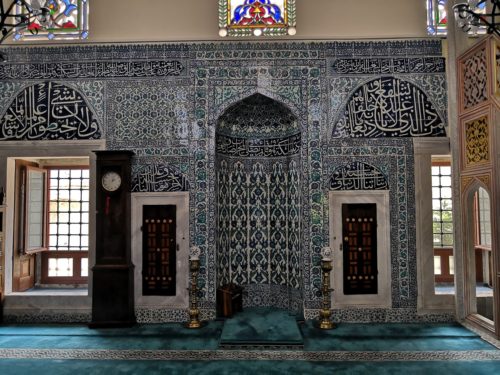
The mosque complex originally included a madrasa and a hammam.

ÇINILI HAMMAM
The Çinili Hammam, built in 1640, is located directly next to the mosque and still functions as a historic bathhouse today.

BÜYÜK VALIDE HAN
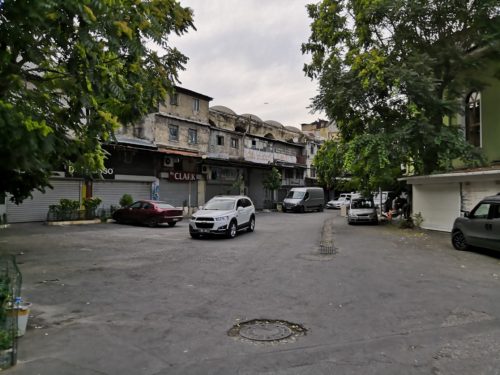
Kosem Sultan also commissioned the Büyük Valide Han, located near the Grand Bazaar in Istanbul’s historic centre. The income from this han financed the operation of the Çinili Mosque.

The Büyük Valide Han was constructed in 1651, on the site of the former Cerrah Mehmed Pasha Palace, dating back to the 16th century.

Although atmospheric and seemingly authentic, the Büyük Valide Han is in desperate need of restoration. Considering its historical value and prime location in the heart of old Istanbul, one can only hope that preservation efforts will take place. Today, the han houses many small businesses.
KOSEM SULTAN TOMB
She was assassinated in 1651 and is buried in the mausoleum of Sultan Ahmed I, next to the Blue Mosque.

Mahpeyker Sultan’s resting place lies beside her husband, Sultan Ahmed I. While visiting Hagia Sophia and the Blue Mosque, make sure to also visit this beautifully decorated mausoleum.
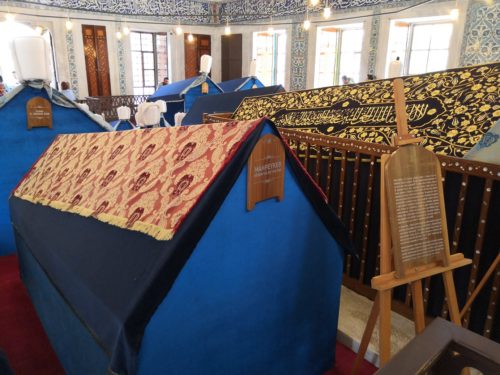
Sultan Osman II and Sultan Murad IV are also buried there, along with many other members of the Ottoman dynasty.

There are many articles about Kosem Sultan available online. However, if you study or simply have an interest in this fascinating chapter of Ottoman history, I hope that this post helps you better understand Kosem Sultan’s life through her enduring legacy in modern-day Istanbul.
She will be remembered forever or, at least, for as long as the remarkable structures bearing her name continue to stand.
Back to Turkey