


WHAT IS SULTANATE OF WOMEN?
This era was marked by the political dominance of wives and mothers of Ottoman sultans. From 1566, following the death of Sultan Suleiman the Magnificent, until 1683, nine different sultans ascended the Ottoman throne. Several of them were minors at the time of their accession. Consequently, their mothers governed the empire from the imperial harem as regents, exercising absolute authority.
This period is particularly compelling for two primary reasons:
- In a predominantly patriarchal Ottoman society, political power was traditionally vested in sultans and their viziers, while women were largely absent from public life
- The second reason is even more striking. With the exception of Mihrimah Sultan, all these women entered Topkapi Palace as young slaves. Through careful selection and in some cases fortune, they became the sultan’s favoured consorts, bore royal heirs and occasionally attained the status of legal wives. In effect, former slave women governed the empire along Grand Viziers, who themselves were often slaves too.
Viewed from this perspective, the Sultanate of Women emerges as an extraordinary historical phenomenon.
Most visitors to Istanbul tend to focus on its most renowned landmarks such as Hagia Sophia, the Blue Mosque, Topkapi Palace and the Grand Bazaar. However, Ottoman Istanbul extends far beyond these iconic monuments.
You can explore the city through many insightful historical lenses. I hope that this text will encourage readers to visit sites associate with these women, to gain a deeper understanding of their historical context and significance.
The women discussed here are Hürrem Sultan, Mihrimah Sultan, Nurbanu Sultan, Safiye Sultan, Kösem Sultan and Turhan Hatice Sultan.
Two additional figures, Handan Sultan and Halime Sultan, also belonged to this period but exercised considerably less influence. Moreover, I could not identify any significant architectural or historical site bearing their names.
HÜRREM SULTAN
Hürrem Sultan’s life may be described, in many respects, as remarkably transformative. Captured at a yound age and brought to Topkapi Palace as a slave, she rose to become one of the most influential women in Ottoman history.
Sultan Suleiman the Magnificent’s devotion to her was such that he broke several long standing dynastic conventions. Hürrem Sultan derived much of her authority from this relationship and played an active role in political affairs of the empire.
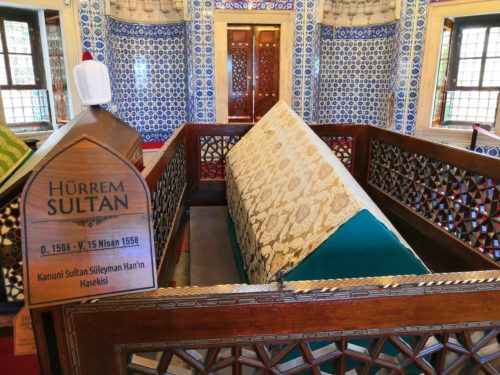
She died in 1558 and was buried in a mausoleum behind the Süleymaniye Mosque. I encourage all visitors to the mosque to also see her elaborately decorated tomb.
MIHRIMAH SULTAN
Among the women that I mention in this post, Mihrimah Sultan was the only one not of servile origin. As the only daughter of Sultan Suleiman the Magnificent and Hürrem Sultan, she became the most powerful Ottoman princess in history.
She derived her influence from two principle sources. First, she was the beloved daughter of Sultan Suleiman and the child of an exceptionally powerful mother. She lived during the apex of Ottoman power, when the empire flourished under Suleiman’s rule.
Second, Mihrimah Sultan married Rüstem Pasha at the age of seventeen. Rüstem Pasha (Rustem-Paša Opuković) was a devşirme, likely of Serbian or Croatian origin, who rose to the position of Grand Vizier.
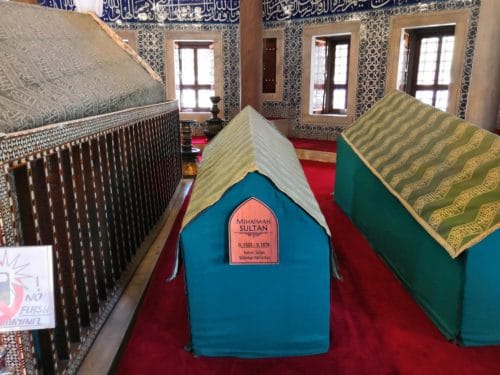
Mihrimah Sultan died in 1578. She was buried beside her father in a mausoleum behind the Süleymaniye Mosque. She remains the only one of his six children interred alongside him.
NURBANU SULTAN
Another former slave who attained immense political authority was Nurbanu Sultan, the legal wife and Haseki Sultan of Sultan Selim II.
Following Selim II’s death, she assumed the role of Valide Sultan as the mother of Sultan Murad III.
Various theories exist regarding her origins. It is widely believed that she came from the Venetian Republic, possibly under the name Cecilia Venier-Baffo. During her nine-year regency, she pursued strongly pro-Venetian policies, which earned her the hostility of the Republic of Genoa. This further supports her Venetian background.
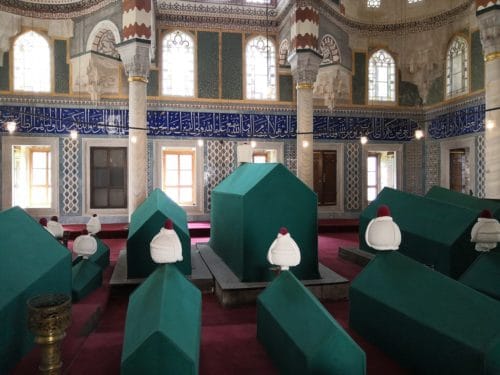
Nurbanu Sultan was buried beside her husband, Sultan Selim II, in a mausoleum adjacent to Hagia Sophia. At the time, Hagia Sophia functioned as an imperial mosque.
SAFIYE SULTAN
Safiye Sultan was the next prominent figure of the Sultanate of Women. As Haseki Sultan and chief consort of Sultan Murad III, her influence expanded significantly following the deaths of Nurbanu Sultan and Murad III. When her son Mehmed III ascended the throne, she became Valide Sutan, thereby holding two most powerful female titles in the Ottoman hierarchy.
Safiye Sultan resided in Topkapi Palace during the reigns of seven sultans: Suleiman the Magnificent, Selim II, Murad III, Mehmed III, Ahmed I, Mustafa I and Osman II.
Between 1595 and 1603, she exercised near absolute authority, governing the empire in collaboration with Gazanfer Ağa, the Chief White Eunuch.
Safiye Sultan is buried in the mausoleum of Sultan Murad III, adjacent to Hagia Sophia.
KÖSEM SULTAN
Kösem Sultan, also known as Mahpeyker Sultan, ruled with exceptional authority and is widely regarded as one of the most prominent women in Ottoman history.
She arrived to Topkapi Palace as a slave. Later, she became Haseki Sultan as the favoured consort and legal wife of Sultan Ahmed I.
Following his death, she assumed the position of Valide Sultan as the mother of Sultan Murad IV and Sultan Ibrahim.
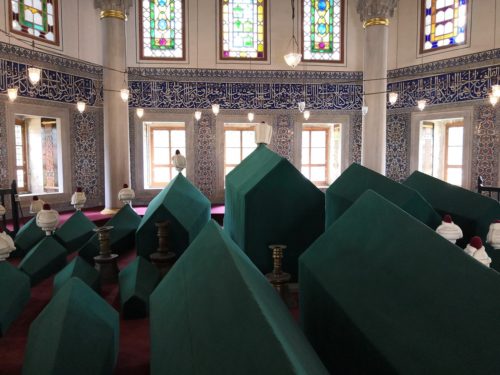
Kösem Sultan if buried in the mausoleum of Sultan Ahmed I, near the Blue Mosque.
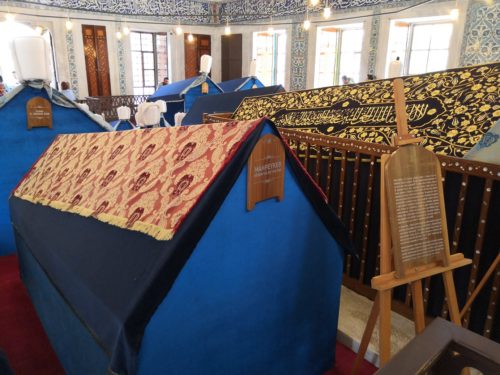
TURHAN HATICE SULTAN
After Kösem Sultan’s death, Turhan Hatice Sultan became Valide Sultan. Her son, Sultan Mehmed IV, was only six years old at the time of his accession, necessitating Turhan Hatice Sultan’s rule as official regent.
She exercised supreme authority and was the only Valide Sultan to share governance directly with her son, surpassing even Kösem Sultan in this regard. Sultan Mehmed IV held her in high esteem and regarded her as a co-ruler.
Turhan Hatice Sultan is buried in a mausoleum opposite the Yeni Mosque, alongside her son Sultan Mehmed IV.

This text has outlined the women who exercised political power during the Sultanate of Women. I will dedicate a separate post to each of these historical figures.
Numerous historical sites in present-day Istanbul bear their names. As I previously noted, a foundational understanding of Ottoman history enables a deeper appreciation of the city’s rich imperial heritage.
In this respect, the Sultanate of Women remains a particularly compelling chapter in Ottoman history.
Back to Turkey
Great weblog right here! Additionally your site so much up very fast! What web host are you using? Can I get your affiliate hyperlink on your host? I wish my website loaded up as quickly as yours lol
December 12, 2020Thanks for your kind words. I’ve checked your site, it looks sleek and it’s also very fast.
December 15, 2020Great work ! I have visited Istambul some times and saw many of those magnificent places myself but I thank very much for a complete story. I knew the stories of all of those women except the last one and it is a great addition to my knowledge. Thanks again !
April 10, 2023Thank you, I agree that the story of all these women is fascinating. Additionally, when you know about the Sultanate of Women, it’s easier to follow Istanbul’s history and all historical buildings and monuments related to them.
April 14, 2023I watched the magnificent century with Hurem an that’s how I gained interest however keep seeing kosem an wondered why she was mentioning. I don’t care to watch the other centuries really but I was curious so thank you for letting me know how she came into the picture. there history is quite fascinating tho..wow I would say. but Hurem is still my favorite and I can’t get myself to watch the other movies or centuries with the other ladies although I may watch the journey of selim an narbanu an Mirihma to be honest and then move on lol they can have their history. hurem is my only interest. if she will come in another century with sulyman of course I’ll watch them. but your vlog really helped. now I see I wasn’t missing anything..thank you so much
February 17, 2024Thanks, I also watched The Magnificent Century, that’s how I started to learn about that part of the Ottoman history. It is all fascinating, especially when you go around Istanbul and see all the places related to these powerful women that I mention in my post.
February 24, 2024I have a doubt that was Mihrimah Sultan in old place during the reign of Selim ll ?? Or she was in the Topkapi place sharing power with Nurbanu
March 23, 2024I believe that Mihrimah Sultan was very powerful while her father Suleiman the Magnificent was alive and while her husband Rustem Pasha held the Grand Vizier position. Perhaps even after that, although I don’t think that Nurbanu would have shared power with Mihrimah. Maybe, there are some records that can confirm this…
March 23, 2024