


WHAT IS SULTANATE OF WOMEN?
This era was marked by the political dominance of wives and mothers of Ottoman sultans. From 1566, following the death of Sultan Suleiman the Magnificent, until 1683, nine different sultans ascended the Ottoman throne. Several of them were minors at the time of their accession. Consequently, their mothers governed the empire from the imperial harem as regents, exercising absolute authority.
This period is particularly compelling for two primary reasons:
- In a predominantly patriarchal Ottoman society, political power was traditionally vested in sultans and their viziers, while women were largely absent from public life
- With the exception of Mihrimah Sultan, all these women entered Topkapi Palace as young slaves. Through careful selection and in some cases fortune, they became the sultan’s favoured consorts, bore royal heirs and occasionally attained the status of legal wives. In effect, former slave women governed the empire along Grand Viziers, who themselves were often slaves too.
Viewed from this perspective, the Sultanate of Women emerges as an extraordinary historical phenomenon.
Most visitors to Istanbul tend to focus on its most renowned landmarks such as Hagia Sophia, the Blue Mosque, Topkapi Palace and the Grand Bazaar. However, Ottoman Istanbul extends far beyond these iconic monuments.
You can explore the city through many insightful historical lenses. I hope that this text will encourage readers to visit sites associated with Hurrem Sultan, to gain a deeper understanding of their historical context and significance.
HURREM SULTAN
Hurrem’s life was, in many ways, the life of a fairy-tale princess. Captured by the Ottomans at a young age, she was brought as a slave to the Topkapi Palace. Yet, she rose to become one of the most powerful women in the history of the Ottoman Empire.
Suleiman the Magnificent loved her so deeply that he broke several long-standing traditions of the Ottoman dynasty because of her. Hurrem Sultan drew her influence from Suleiman’s affection and played a remarkably active role in state affairs.
So, which rules of the Ottoman dynasty did Suleiman break?
The First Sultan in 200 Years to Marry His Concubine
Suleiman married her in a grand ceremony in either 1534 or 1535. A union that shattered a 200 year old custom forbidding sultans from marrying their concubines. Through this marriage, Hurrem became Suleiman’s legal wife.
Interestingly, Orhan Gazi was the last Ottoman sultan to marry before Suleiman, ruling near two centuries earlier.
The First “Haseki Sultan” in Ottoman History
Additionally, Hurrem became the first imperial consort to receive the title Haseki Sultan. This highly prestigious title elevated her status above that of Ottoman princesses, akin to the rank of an empress in European courts.
The Ottomans continued to use this title for another 100 years, most prominently during the Sultanate of Women. In addition to being freed from slavery, the Haseki Sultan title lifted Hurrem, a former concubine, into one of the highest positions in Ottoman society.
A Mother of Six – Defying Harem Tradition
Next, Hurrem bore six children for Suleiman. One of her sons, Selim II, succeeded his father as sultan. However, she never held the title Valide Sultan because she died before Selim ascended the throne.
This situation broke another major rule of the Ottoman harem – one concubine mother, one son. Suleiman allowed Hurrem to have more than one son. In fact, she bore him five sons.
A Lifetime in the Imperial Palace
Another significant tradition that Suleiman broke for Hurrem was allowing her to remain in the imperial palace in Istanbul for her entire life. Traditionally, princes left the palace at age 16 or 17, to govern distant provinces. Their mothers accompanied them. They returned to the Topkapi Palace only if their son became sultan.
Hurrem, however, stayed in the palace and remained close to her youngest son, Cihangir, who was hunchbacked.
Finally, Hurrem moved from the Eski Palace to the Topkapi Palace itself. This move defied a decree issued earlier by Fatih Sultan Mehmed. It banned women from living in the Topkapi Palace, as it served as the centre of government.
HASEKI HURREM SULTAN HAMMAM
The Haseki Hurrem Sultan Hammam stands between the Hagia Sophia and the Blue Mosque, perhaps the most iconic pedestrian route in Istanbul. This means that everyone walking between these two world-famous landmarks passes by her hammam. Although, I believe, very few people realise what it is. Its extraordinary location highlights Hurrem’s power, significance and influence.
Designed by Mimar Sinan in 1556, the hammam has retained its original form for 470 years. It was the first bathhouse built with symmetrical men’s and women’s sections, aligned on the same axis.
At the time it was constructed, the Blue Mosque did not yet exist. Sultan Ahmed I built it roughly 60 years later.
The hammam functioned until 1910. Afterwards, it housed prisoners from the nearby Sultanahmet prison. Later, it served as a carpet exhibition hall until 2007.
Today, it operates as a functioning hammam once again.
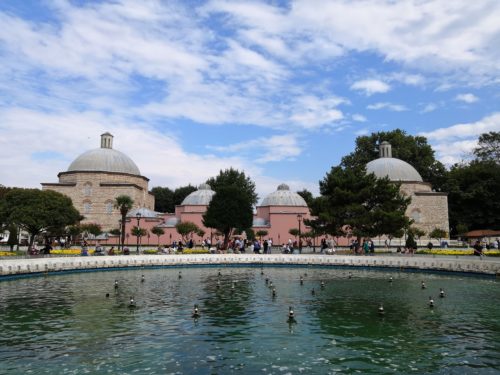
HASEKI HURREM SULTAN FOUNTAIN
A beautiful Haseki Hurrem Sultan fountain is attached to the hammam.
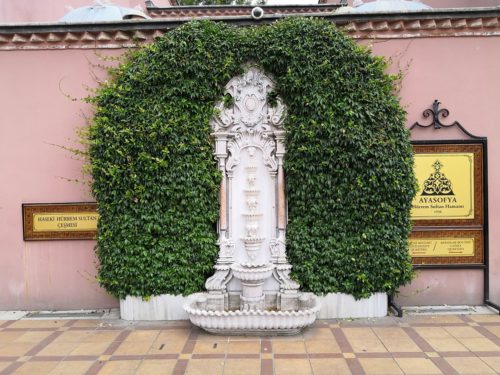
HASEKI SULTAN COMPLEX
The second major historic site associated with Hurrem is the Haseki Sultan Complex, consisting for a mosque, madrasa, hospital (darüşşifa), elementary school (mektep) and soup kitchen (imaret).
When I visited this historic site in 2019, it was closed for restoration. So, it was at the top of my list when I returned to Istanbul in June 2024.

As you can see from the photos, the restoration of the mosque has been completed. However, I was unable to see the full complex because it remained closed. I plan to return, to visit the entire site on my next trip to Istanbul.

Hurrem commissioned and financed the construction of this complex soon after her marriage to Suleiman, using her own dowry.

What makes this complex especially significant is that it was Mimar Sinan’s first major imperial project. He completed it in phases – the mosque in 1539, the madrasa in 1540, the soup kitchen in 1541 and the hospital in 1551.

Sultan Suleiman the Magnificent had his first son, Mustafa, with another woman, Mahidevran. As far as I know, there are no major monuments dedicated to Mahidevran. Although, you can visit her tomb within the Muradiye Complex in Bursa. She is buried next to her son.

The presence of the hammam near Hagia Sophia, the Haseki Sultan Complex and Hurrem’s mausoleum all demonstrate how much Suleiman loved her. These structures also reinforce her exceptional status in Ottoman history.

HURREM SULTAN MAUSOLEUM
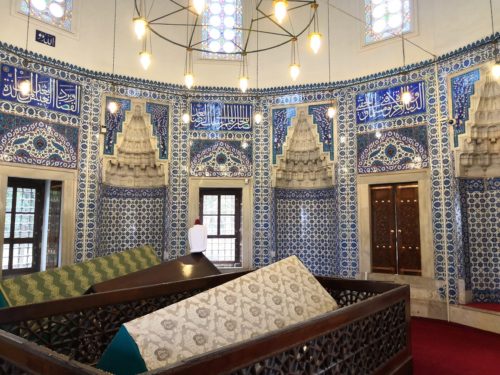
She died in 1558 and is buried in a mausoleum behind the Süleymaniye Mosque.
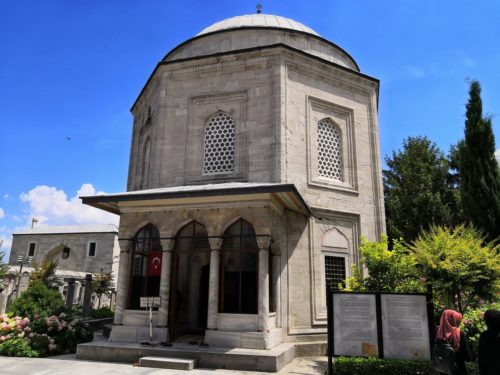
Interestingly, unlike some other powerful women of the Sultanate of Women period, she is not buried in the same mausoleum as Suleiman. This is likely because she died before him and therefore had her own separate structure built for her burial.
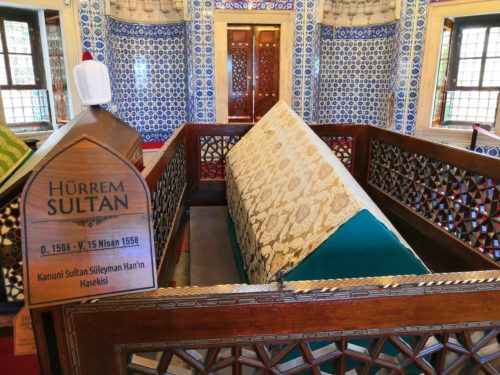
If you visit the Süleymaniye Mosque, make sure to see her beautifully decorated tomb as well.
You can find many articles about Hurrem Sultan online. However, if you are interested in or studying this fascinating part of Ottoman history, I hope that this post helps you better understand Hurrem’s life through the legacy she left in modern-day Istanbul.
With so many historic buildings bearing her name, Hurrem will be remembered for generations or, at least, as long as these architectural monuments stand.
It’s truly remarkable what a woman who began her life in the Ottoman Palace as a slave girl achieved.
Back to Turkey