


WHAT IS SULTANATE OF WOMEN?
This era was marked by the political dominance of wives and mothers of Ottoman sultans. From 1566, following the death of Sultan Suleiman the Magnificent, until 1683, nine different sultans ascended the Ottoman throne. Several of them were minors at the time of their accession. Consequently, their mothers governed the empire from the imperial harem as regents, exercising absolute authority.
This period is particularly compelling for two primary reasons:
- In a predominantly patriarchal Ottoman society, political power was traditionally vested in sultans and their viziers, while women were largely absent from public life
- With the exception of Mihrimah Sultan, all these women entered Topkapi Palace as young slaves. Through careful selection and in some cases fortune, they became the sultan’s favoured consorts, bore royal heirs and occasionally attained the status of legal wives. In effect, former slave women governed the empire along Grand Viziers, who themselves were often slaves too.
Viewed from this perspective, the Sultanate of Women emerges as an extraordinary historical phenomenon.
Most visitors to Istanbul tend to focus on its most renowned landmarks such as Hagia Sophia, the Blue Mosque, Topkapi Palace and the Grand Bazaar. However, Ottoman Istanbul extends far beyond these iconic monuments.
You can explore the city through many insightful historical lenses. In this post, you will discover historic sites in Istanbul linked specifically to Mihrimah Sultan. Of course, these are not the only buildings associated with her. She likely commissioned other structures across Istanbul and the wider Ottoman Empire.
MIHRIMAH SULTAN
Mihrimah Sultan was not a slave. As the only daughter of Suleiman the Magnificent and Hürrem Sultan, she was the most powerful princess in Ottoman history.
Her influence came from two sources. She was deeply loved by her father and she had an extraordinarily influential mother. She lived during the height of the empire’s power and prosperity under Suleiman’s reign.
Mihrimah married Rüstem Pasha at age 17. Rüstem Pasha (Rustem-Paša Opuković) was a devşirme, likely of Serbian or Croatian origin. He rose the ranks to become Suleiman’s Grand Vizier.
Together with Hürrem Sultan and Rüstem Pasha, she may have played a role in the downfall of her half-brother Şehzade Mustafa.
Mustafa, Suleiman’s eldest son with Mahidevran Hatun, was the next in line for the throne. Had he become sultan, Ottoman fratricide customs meant that all of Mihrimah’s full brothers would likely have been executed. Suleiman ultimately ordered Mustafa’s death in 1553, believing he planned to rebel.
Mihrimah’s full brother Selim II later become sultan and executed their other surviving full brother, Bayezid.
Mihrimah Sultan commissioned two imperial mosques in Istanbul.
MIHRIMAH SULTAN MOSQUE IN ÜSKÜDAR
When you cross from European Istanbul to the Asian side, the first major historic structure you see upon arriving in Üsküdar is the Mihrimah Sultan Mosque.
Constructed in 1548 by the great imperial architect Mimar Sinan, the complex originally included a madrasa, soup kitchen, primary school and hospital.
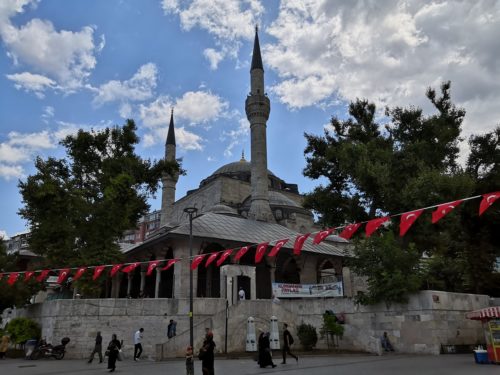
According to legend, Sinan was in love with Mihrimah Sultan and even proposed marriage, but Suleiman refused.
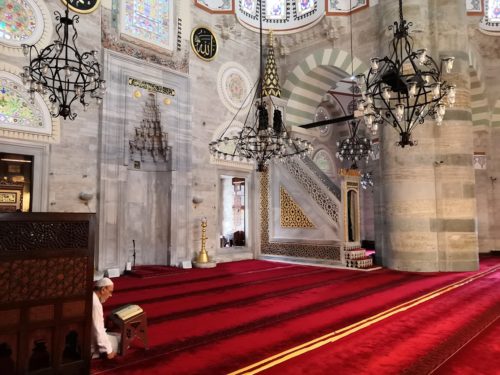
If you travel to Istanbul, make sure to visit Üsküdar. The ferry ride across the Bosporus is one of the city’s most enjoyable public transport experiences, offering breath-taking views.
The district contains many historic sites, including structures linked to other powerful women of the Sultanate of Women era.
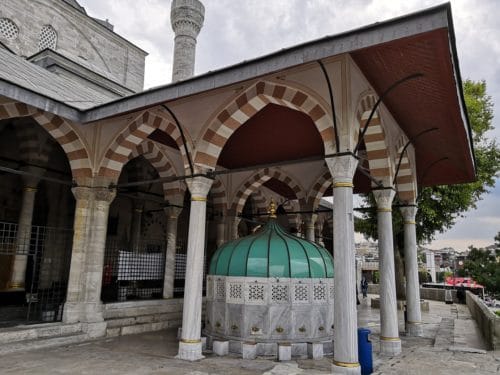
FOUNTAIN
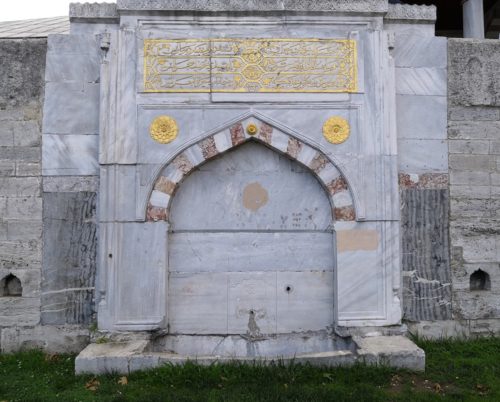
A beautiful Ottoman fountain stands attached to the mosque, although it was not functioning when I took the photo below.
MIHRIMAH SULTAN MOSQUE IN EDIRNE GATE
The second Mihrimah Sultan Mosque is located in Istanbul’s old city, near Edirne Gate. Mimar Sinan built this mosque around 1570, along with a madrasa and a hammam.

The mosque is near the Chora Church, Tekfur Palace and the Theodosian Walls. It is a much larger and more monumental structure than its Üsküdar counterpart.

However, its location far from Istanbul’s most visited tourist areas means that relatively few visitors ever see it.
When I explored Ottoman heritage extensively in 2019, I had no idea this second mosque existed. It never occurred to me that two separate imperial mosques could be dedicated to Mihrimah Sultan.
Centuries after her death, these two monumental mosques still reflect her exceptional status and influence. Very few individuals, male of female, have two grand imperial mosques bearing their name in Istanbul.

HAMMAM
The hammam belonging to the Mihrimah Sultan Complex remains operational today, more than 450 years after it was built.

MIHRIMAH SULTAN TOMB
Mihrimah likely remained in Topkapi Palace, sharing power with the new Valide Sultan, Nurbanu Sultan, mother of Sultan Murad III.
She was certainly more powerful than Murad’s wife, Safiye Sultan.
The position of women in the imperial palace depended heavily on the ruler’s lifespan. Mihrimah remained secure while her brother Sultan Selim II lived, but he died in 1574.
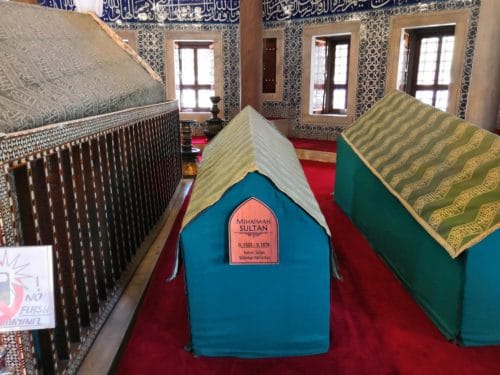
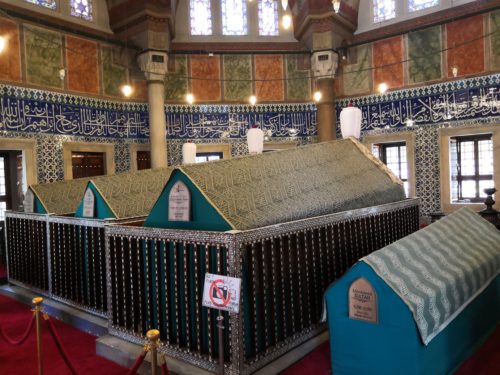
She passed away four years later, in 1578, and was buried beside her father in his mausoleum behind the Süleymaniye Mosque. She is the only one of his six children to be interred with him.
Many articles about Mihrimah Sultan exist online but, if you study or simply enjoy this captivating chapter of Ottoman history, I hope this post helps you better understand her life through her architectural legacy in modern-day Istanbul.
With two monumental mosques built in her honour, her name and influence will endure for as long as these remarkable structures stand.
Back to Turkey