


WHAT IS SULTANATE OF WOMEN?
This era was marked by the political dominance of wives and mothers of Ottoman sultans. From 1566, following the death of Sultan Suleiman the Magnificent, until 1683, nine different sultans ascended the Ottoman throne. Several of them were minors at the time of their accession. Consequently, their mothers governed the empire from the imperial harem as regents, exercising absolute authority.
This period is particularly compelling for two primary reasons:
- In a predominantly patriarchal Ottoman society, political power was traditionally vested in sultans and their viziers, while women were largely absent from public life
- With the exception of Mihrimah Sultan, all these women entered Topkapi Palace as young slaves. Through careful selection and in some cases fortune, they became the sultan’s favoured consorts, bore royal heirs and occasionally attained the status of legal wives. In effect, former slave women governed the empire along Grand Viziers, who themselves were often slaves too.
Viewed from this perspective, the Sultanate of Women emerges as an extraordinary historical phenomenon.
Most visitors to Istanbul tend to focus on its most renowned landmarks such as Hagia Sophia, the Blue Mosque, Topkapi Palace and the Grand Bazaar. However, Ottoman Istanbul extends far beyond these iconic monuments.
You can explore the city through many insightful historical lenses. In this post, you will discover historic sites in Istanbul linked specifically to Nurbanu Sultan. Of course, these may not be the only buildings associated with her. She may have commissioned other structures across Istanbul and the wider Ottoman Empire.
NURBANU SULTAN
Another former slave girl who rose to ultimate power in the Ottoman Empire was Nurbanu Sultan. She was the legal wife and Haseki Sultan of Sultan Selim II.
After Selim’s death, she became Valide Sultan, as the mother of Sultan Murad III.
There are several theories about her origins. The most widely accepted is that she came from the Venetian Republic, possibly born as Cecilia Venier-Baffo. Her strong pro-Venetian stance during her nine-year regency fuelled hostility from the Republic of Genoa, further supporting the idea of her Venetian background.
Known for her intelligence and beauty, Nurbanu was Sultan Selim II’s favoured consort.
Like Hürrem Sultan, she lived in Topkapi Palace throughout her husband’s reign. Selim frequently sought her counsel, valuing her judgment and relying on her as an advisor.
She was so influential that some sources claim she effectively governed the empire from 1574 to 1583, alongside Grand Vizier Sokollu Mehmed Pasha.
When Sultan Selim II died, Nurbanu hid his body for twelve days, long enough for her son, Şehzade Murad, to travel from Manisa to Istanbul and secure the throne. In doing so, she prevented rivals from seizing power.
When her son became sultan, she assumed the title of Valide Sultan, the highest position attainable for a woman in the Ottoman Empire.
ATIK VALIDE MOSQUE
The chief imperial architect Mimar Sinan built the magnificent Atik Valide Mosque and its surrounding complex in her honour. Located in Üsküdar, on the Asian side of Istanbul, it remains one of Sinan’s most impressive works.
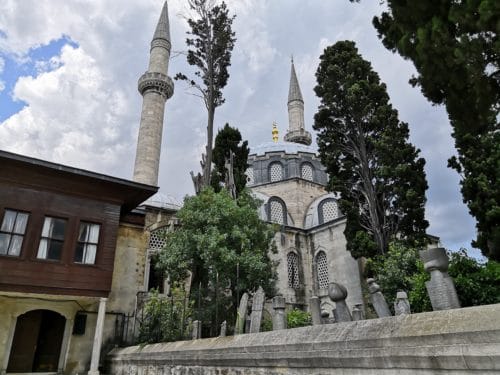
Sinan constructed the complex in three stages. He built the first version of the mosque between 1571 and 1574.
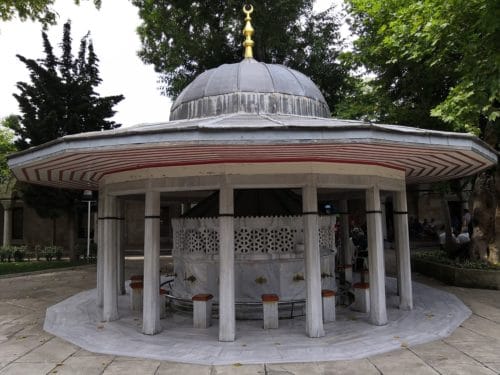
The second phase took place between 1577 and 1578, when Sinan expanded the mosque to reflect Nurbanu’s elevated status as Valide Sultan.

The final stage of construction took place between 1584 and 1586, after Nurbanu’s death.

The complex included the mosque, also a madrasa, a hadith college, a Quran school, an elementary school, a dervish lodge, a hospital and a hospice featuring a guest-house and a double caravanserai.
At the time, the Atik Valide Complex was among the largest in Istanbul.

NURBANU SULTAN FOUNTAIN
The Nurbanu Sultan Fountain forms part of the Atik Valide Mosque complex.
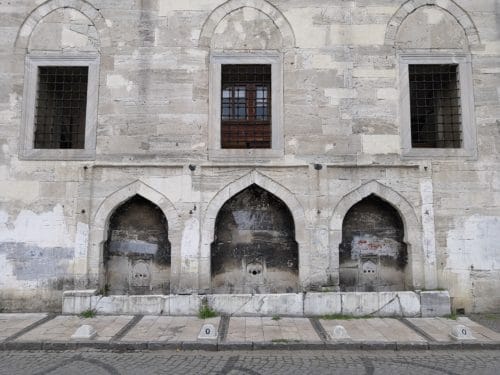
ATIK VALIDE HAMMAM
A short distance from the mosque stands the Atik Valide Hammam, built in 1579. It is still a fully operational bath-house.

ÇEMBERLİTAŞ HAMMAM
Nurbanu Sultan also commissioned the Çemberlitaş Hammam as a revenue source to fund the construction of new religious complexes, including the Atik Valide Mosque.
This historic bath was built in 1584 by Mimar Sinan and remains in use. During one of my first visits to Istanbul, I experienced this hammam without knowing its remarkable history. I recall it being both beautiful and memorable inside.

NURBANU SULTAN MAUSOLEUM
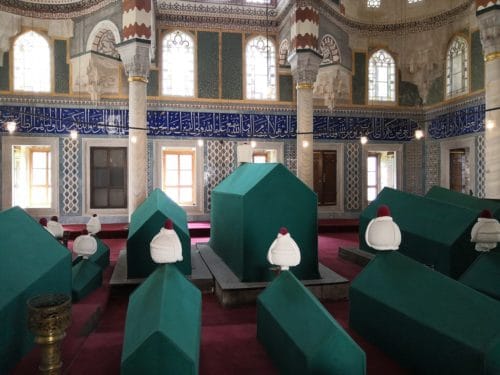
Nurbanu Sultan died in 1583 and is buried next to her husband, Sultan Selim II, in the mausoleum beside Hagia Sophia, which was an imperial mosque at the time.
She was the first sultan’s wife to be buried beside her husband, a break from Ottoman tradition. For example, Hürrem Sultan rests in a separate mausoleum.
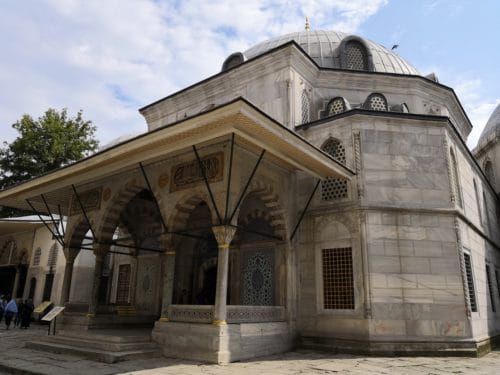
There are no identifying markers on the sarcophagi, although it is likely that Selim’s and Nurbanu’s coffins occupy the central position. Exquisite Iznik tiles adorn the interior.
You can find many articles about Nurbanu Sultan online. However, whether you study Ottoman history or simply find this era fascinating, I hope this posts helps you better understand Nurbanu’s life through the legacy she left in modern-day Istanbul.
With these structures bearing her name, she will be remembered for generations or, at least, for as long as these monuments stand.
Back to Turkey