


Hagia Sophia was a museum in 2019. The ticket to enter was 6o Turkish liras, which was approximately 10 euros at that time.
However, under the pretext that it is the property of Fatih Sultan Mehmed’s foundation, they re-converted Hagia Sophia into a mosque in 2020. Initially, the entrance was free, but now they charge 25 euros to enter. Despite this eye watering price, there was a long queue of tourists waiting to buy tickets when I was there at the beginning of June 2024.
In my opinion, it’s either a mosque or a museum. If it’s a mosque, the fee shouldn’t be charged.
HAGIA SOPHIA – BYZANTINE WONDER
I published a lot of posts from my Turkish trip six years ago. But at that time, I decided not to write about Hagia Sophia for two reasons.
The first reason is that so much has already been written about this Byzantine wonder. I was sure that my post would be lost in the ocean of available articles on the internet.
The second reason is that I wasn’t entirely happy with the photos. So, I decided to wait until the next time I was in Istanbul, in order to take better pictures. However, it seems that I will probably never take any new photos. I am reluctant to pay 25 euros to enter a mosque.
More importantly, from what I’ve read, you can now see only a small part of Hagia Sophia. They have selected one section of the upper gallery for tourist visits. Unless you go there to pray, you will no longer be able to see this iconic structure from its ground floor perspective.
Even worse, you will probably never be able to see some of Hagia Sophia’s legendary mosaics, as they are covered. The floor is carpeted, so you can no longer see the original floor and the coronation square.
Basically, you now have to pay a much higher fee to see much less than what was accessible in the past.
Thus, I’m publishing this post because I’d like to convey the magic of this former Christian Orthodox Byzantine wonder to people who have never seen it. But even if you go now, you most likely won’t see the images that appear in this post.
SHORT HISTORY OF HAGIA SOPHIA
Built in 537, it served as a Christian Orthodox temple until 1453. Fatih Sultan Mehmed converted it into a mosque literally three days after he conquered Constantinople.
Being one of the world’s greatest monuments, Hagia Sophia became a museum in 1934. This happened after the establishment of the Turkish secular republic under the leadership of the Father of the Nation – Mustafa Kemal Atatürk. Turning Hagia Sophia into a museum was undoubtedly a symbolic move.
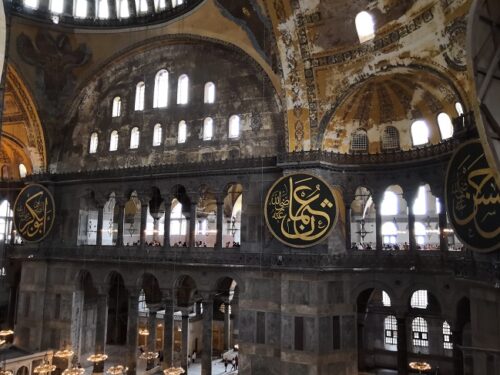
The conversion of Hagia Sophia into a mosque in 1453 marked the beginning of Islamic rule over what had been Christian territory until then. Likewise, the conversion of Hagia Sophia into a museum in 1934 marked the establishment of the Turkish secular republic.
Hagia Sophia is again a mosque, but Turkey is still a secular state. I believe, it will remain so forever. At this point, I no longer see how they could go back in time and establish an Islamic state. But perhaps I’m wrong. The strangest things can happen, with Hagia Sophia being a clear example of that.
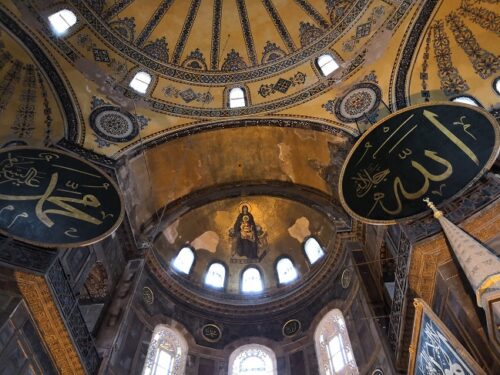
VIRGIN AND CHILD
The mosaic of the Virgin and Child is the oldest and most valuable mosaic in Hagia Sophia. Located in the apse of the former church, it is directly above the mihrab and therefore covered by curtains.
I don’t know if they open the curtains outside prayer times. I also don’t know whether you can see this image properly from the upper gallery.
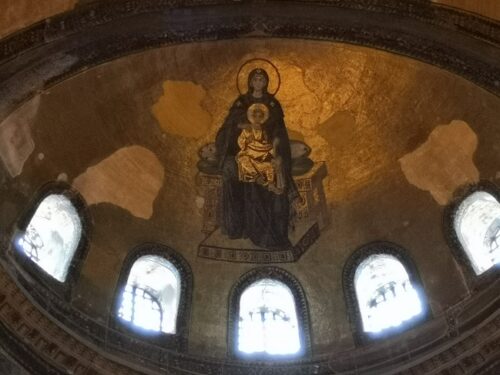
ISLAMIC ELEMENTS
You can see both the mosaic and the mihrab in the photo below. The mihrab indicates the direction of Mecca.
Sultan Suleiman the Magnificent took the two bronze lamps on each side of the mihrab as loot after the Budapest military campaign.

The minbar was added during the reign of Sultan Murad III.
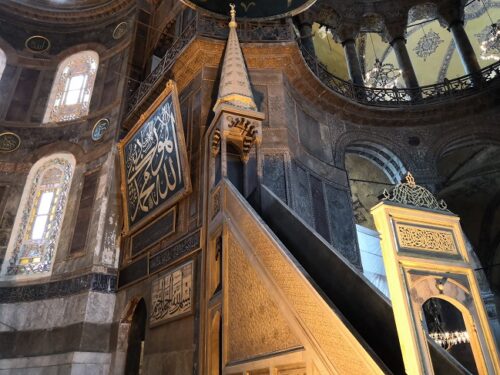
Sultan Mahmud I built the library in 1739. It consists of a reading room and library, decorated with 16th and 18th century Iznik, Kütahya and Tekfur Palace tiles.
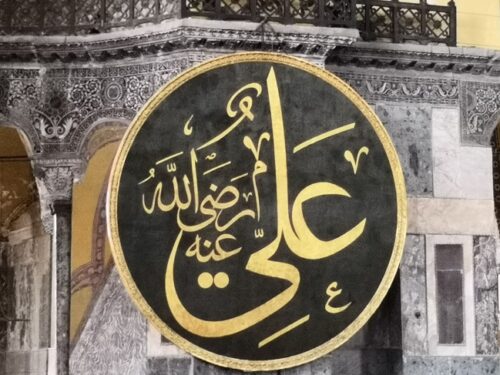
One of the most famous calligraphers of the period, Kazasker Mustafa Izzet Efendi, wrote the calligraphic roundels between 1847 and 1849 that you can see hanging on the walls of the central area.
There are two lustration urns in Hagia Sophia, I took a photo of one of them. They belong to the Hellenistic period (330-30 BC). Sultan Murad III brought them from the ancient city of Pergamon.

CHRISTIAN ORTHODOX MOSAICS
The mosaics that you can see in these photos are all on the upper gallery of this Byzantine wonder. I don’t know whether it’s possible to see all of them under the new rules for foreign visitors.
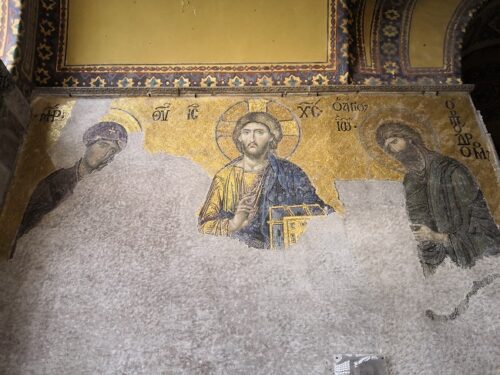
This 13th century mosaics depicts Christ in the middle, John the Baptist on the right and Virgin Mary on the left.
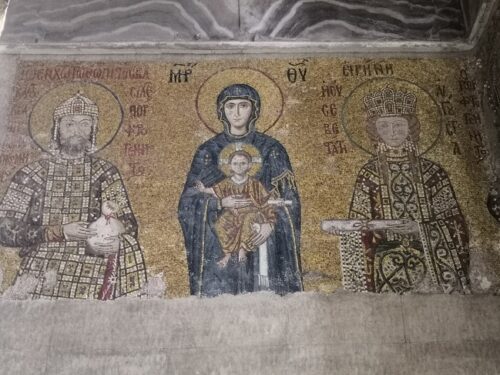
In this 12th century mosaic, Virgin Mary is in the middle with the Child in her arms, Emperor John II Komnenos on the left and his wife Eirene on the right.
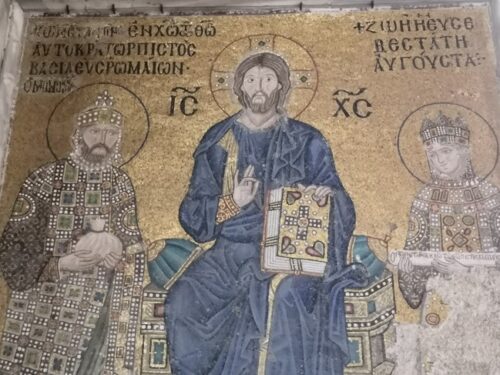
Finally, this 11th century mosaic shows Christ on the throne in the middle, Emperor Constantine IX Monomachos on the left and Empress Zoe on the right.
BYZANTINE WONDER – MUSEUM OR MOSQUE?
Was it necessary to re-convert Hagia Sophia into a mosque?
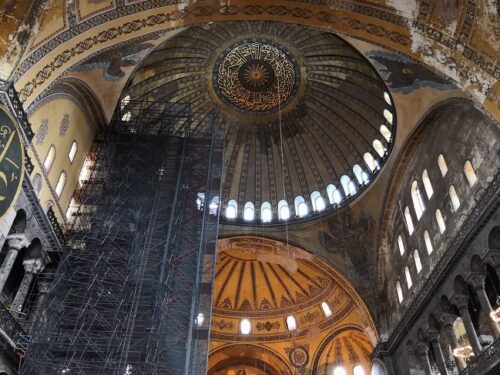
I suppose it doesn’t really matter as long as they take good care of this very precious building. You can see a large scaffolding in the photo below. Keep in mind that the photo is six years old, although I believe restoration work is still ongoing.
I can only think of the Pantheon in Rome as an equivalent to Hagia Sophia. Also an ancient building, the Pantheon is a functioning Catholic church, but they charge 5 euros to enter.
No fee should be charged to enter a church or a mosque as a matter or principle. In Istanbul, you don’t have to pay to enter any other mosque. But the current ticket price is extortionate, especially because you can no longer stand under the dome and marvel at Hagia Sophia’s immense size and beauty.
Back to Turkey